
Railway Suspension Springs
Hot-coiled helical springs engineered for railway bogie suspension — manufactured to drawing under CRCC and ISO 9001 certification.
Overview
Railway suspension springs are large-diameter helical compression springs that carry the weight of railway vehicles and absorb the dynamic loads generated during operation. They are produced by hot-coiling: spring steel bar is heated to forging temperature and wound into coil form, which is the practical way to form the heavy bar sections used in locomotive, coach, freight wagon and metro suspension systems.
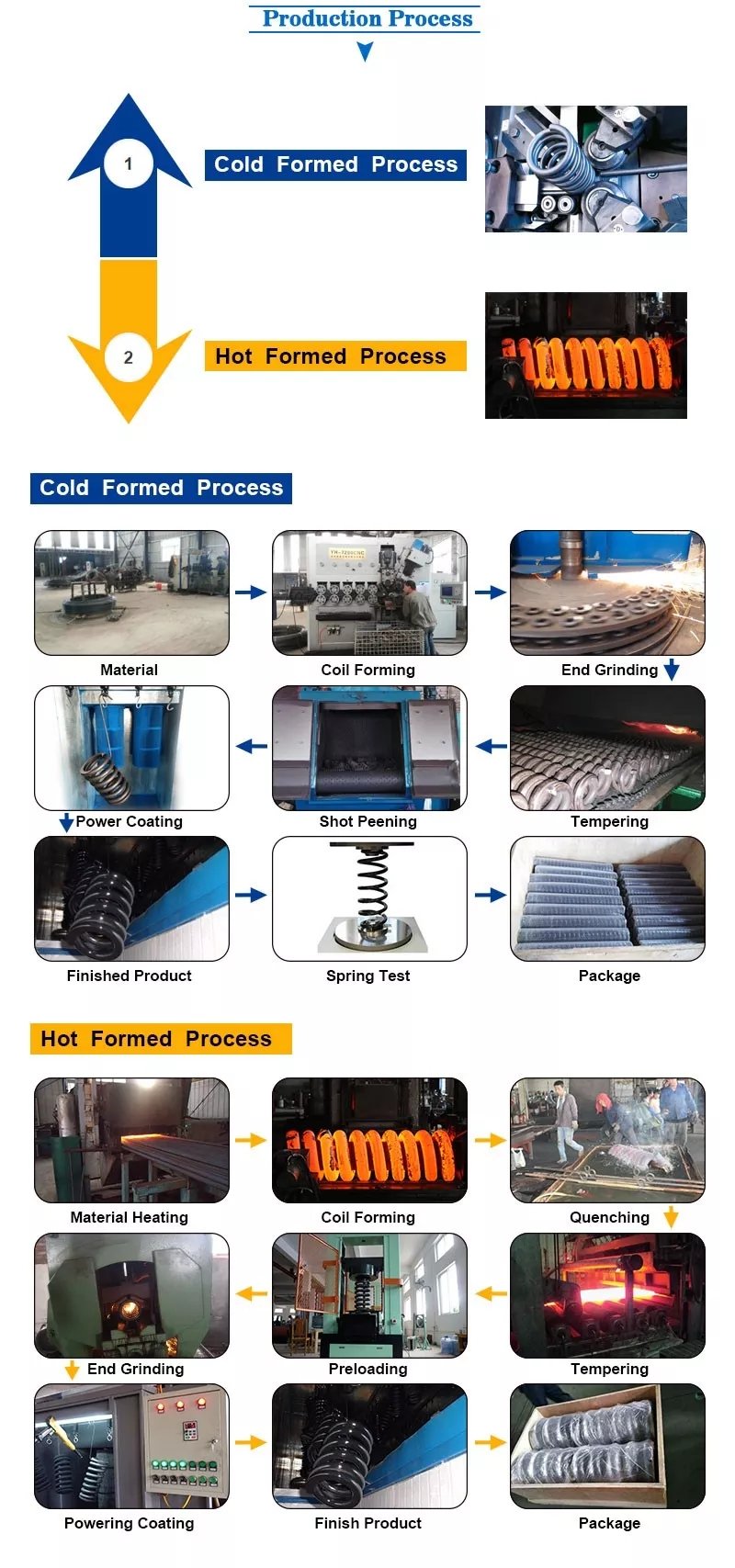
CHENJI manufactures both primary (axle box) and secondary (body) suspension springs for railway rolling stock. Our hot-forming line covers the complete process chain in-house, from bar cutting and heating through coiling, heat treatment, grinding, pre-setting, shot peening and inspection. Every spring is produced to the customer’s drawing.
Railway springs must survive millions of load cycles in service, so consistency is everything: stable free height, accurate spring rate and predictable fatigue life. We combine controlled heat treatment, shot peening, pre-setting and full inspection to deliver springs that keep their properties over a long service life.
Hot-Coil Manufacturing Process
Every railway suspension spring passes through the full hot-forming process chain in our own workshop:
- Bar cutting — spring steel bar is cut to the exact weight and length for the target coil geometry.
- Heating and coiling — the bar is heated uniformly and wound hot on our coiling equipment.
- Quenching — the coiled spring is quenched to achieve the required hardness and structure.
- Tempering — tempering restores toughness and sets the final mechanical properties.
- End grinding — the ends are ground flat and square for even load distribution.
- Pre-setting (scragging) — springs are compressed beyond yield to stabilize free height.
- Shot peening — the surface is peened to build compressive residual stress for fatigue life.
- Magnetic particle inspection — surface and near-surface defects are detected.
- Final inspection and packing — dimensional, load-rate and visual checks, then protective packing.
Primary and Secondary Suspension
Railway bogie suspension is arranged in two stages, and CHENJI manufactures springs for both stages.
Primary suspension (axle box springs) — installed between the wheelset axle box and the bogie frame. Primary springs carry the vehicle weight at the wheels, distribute wheel loads evenly and absorb track-induced shocks and high-frequency vibration. They directly influence ride quality, wheel/rail forces and running stability.
Secondary suspension (body springs) — installed between the bogie and the car body. Secondary springs carry the mass of the car body, isolate passengers and freight from vibration and noise, and allow controlled movement between body and bogie. They are typically the largest springs on the vehicle.
See our Primary Suspension Springs and Secondary Suspension Springs pages for detailed information.
Standards and Specifications
We produce railway suspension springs strictly to the customer’s drawing and specification. Depending on the market and application, springs can be engineered, tested and documented to DIN, UIC, EN, JIS and GB/T requirements, including TB/T 2211 for Chinese rolling stock suspension springs.
For every order we confirm the material grade, dimensional tolerances, load/deflection characteristics, surface finish and inspection scope before production, and we issue the corresponding inspection and test documentation with delivery.
Certified Quality
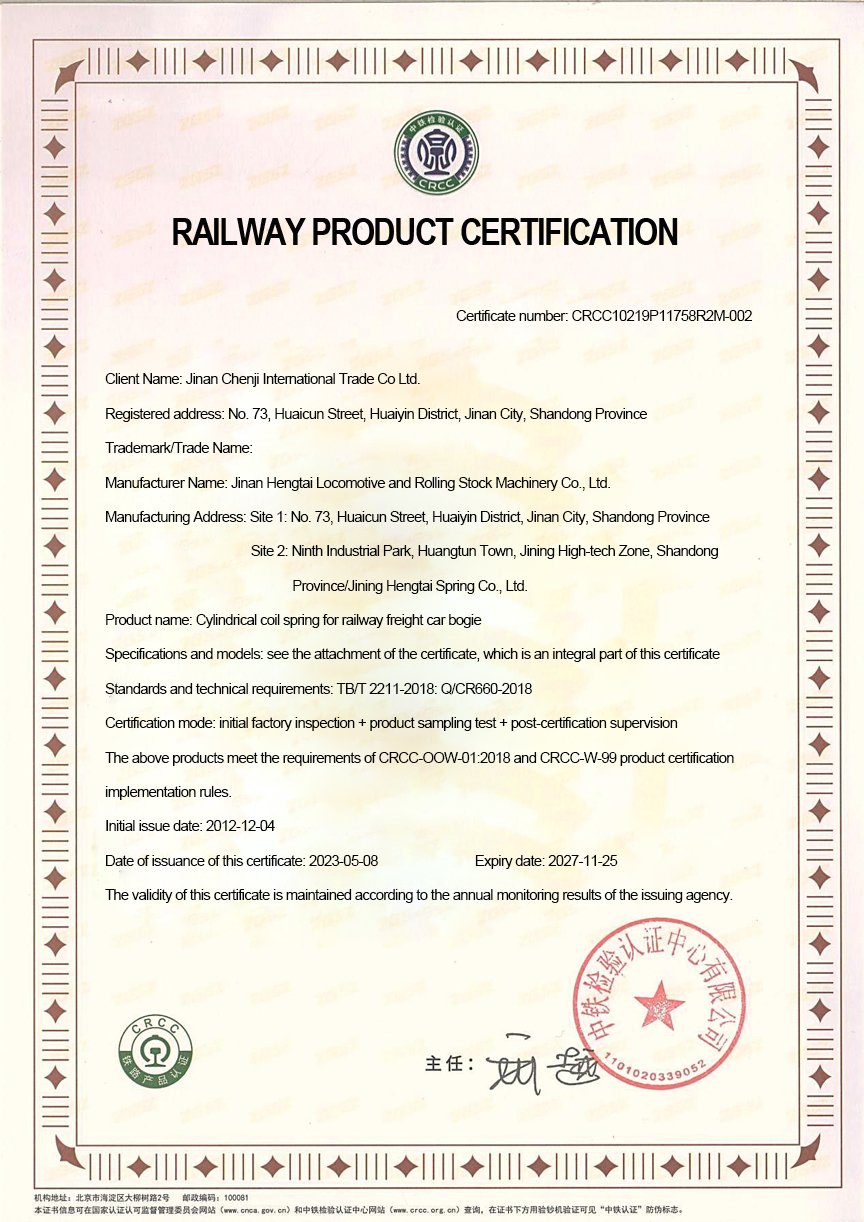
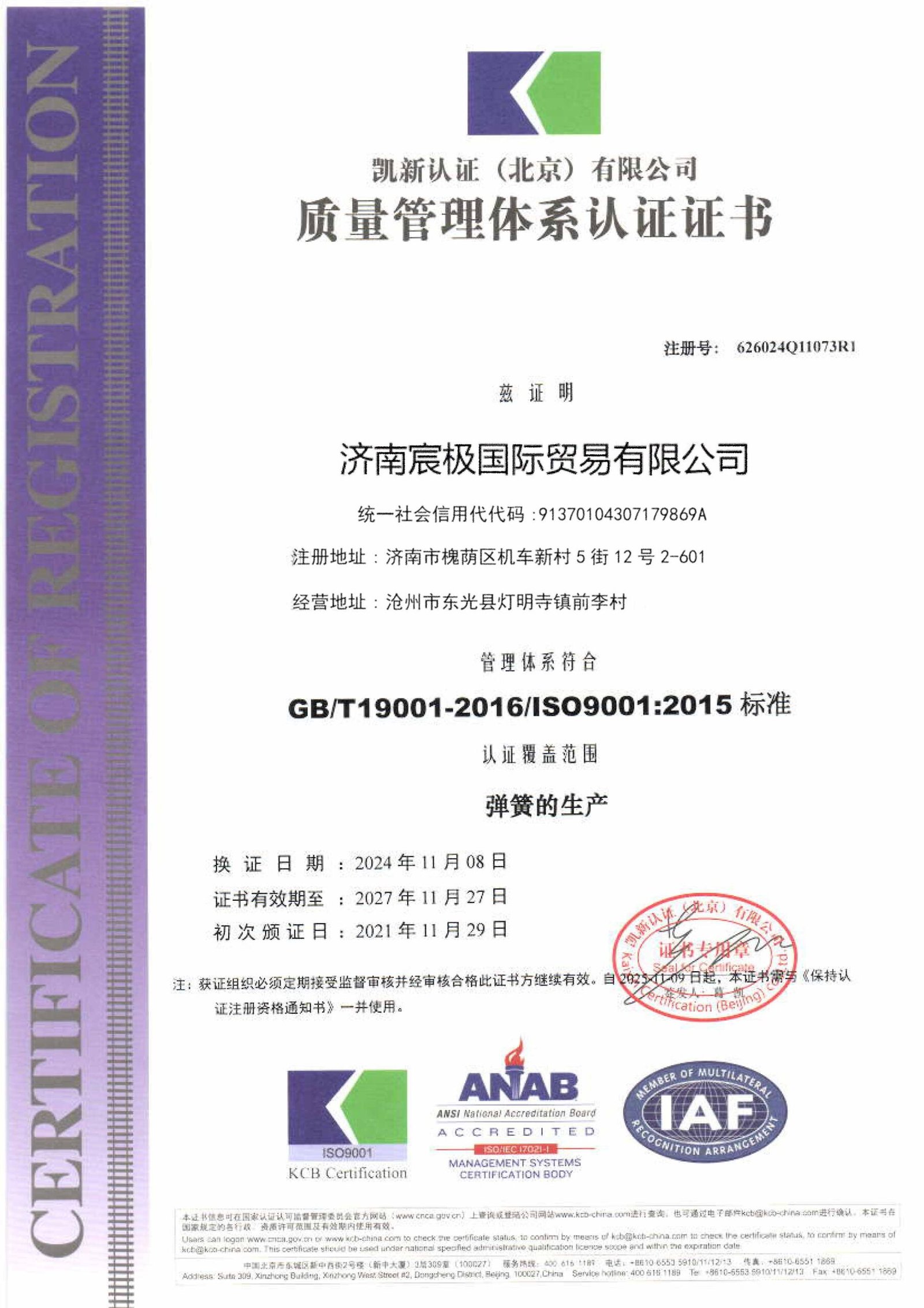
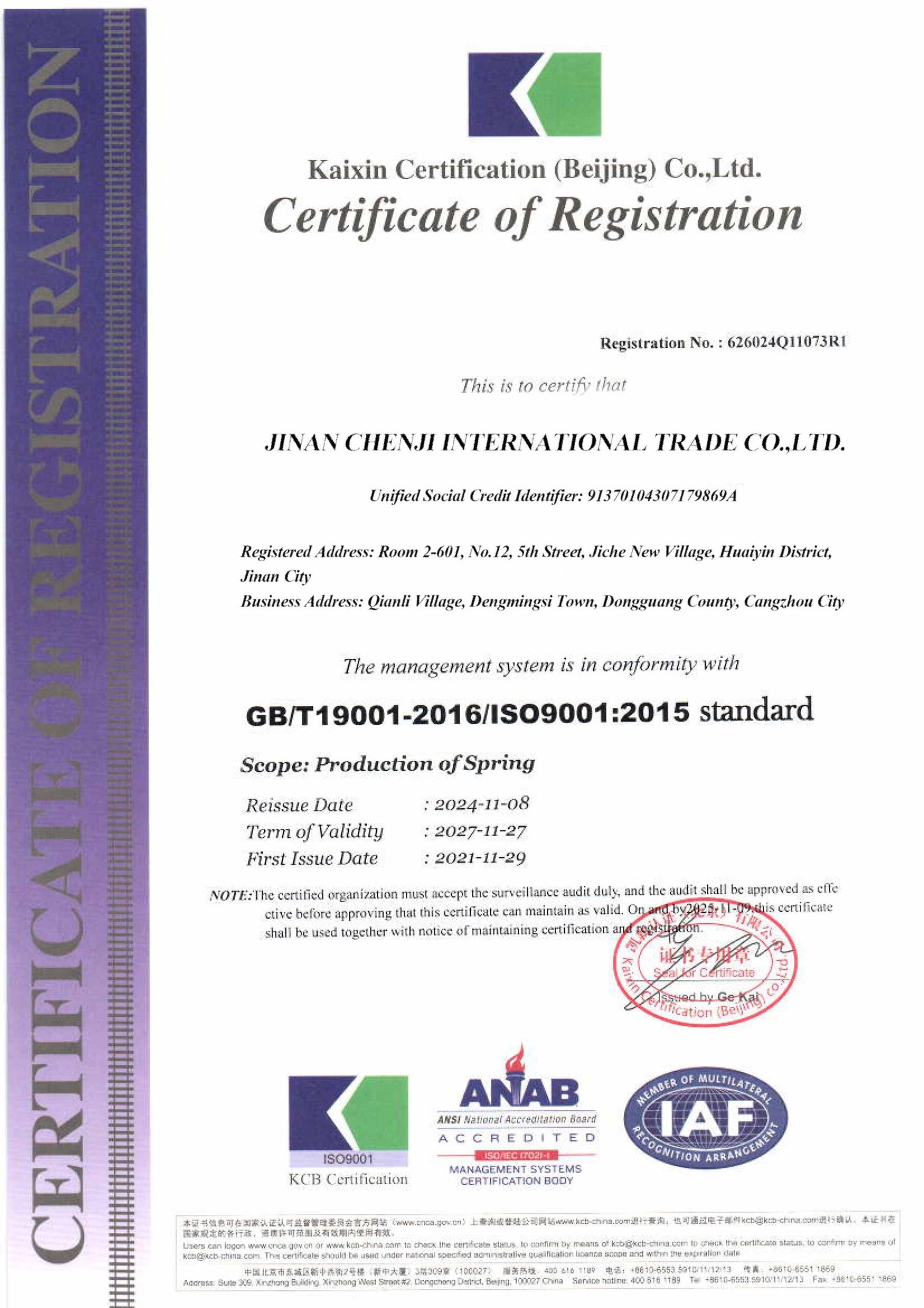
Railway suspension springs are manufactured under an ISO 9001 quality management system and CRCC railway product certification (certificate no. CRCC10219P11758R2M).
Custom Manufacturing Process
From drawing to series production in three steps:
Send Your Drawing
Share your drawing or specification — dimensions, material grade, load and deflection requirements, and quantity.
Sampling and Validation
We produce samples, run dimensional and load testing, and confirm the results with you before mass production.
Series Production
Approved samples move to batch production with in-process inspection, testing and on-time delivery.
Frequently Asked Questions
Q: What is the difference between primary and secondary suspension springs?
Primary (axle box) springs sit between the wheelset and the bogie frame; secondary (body) springs sit between the bogie and the car body. CHENJI manufactures both — see the Primary Suspension Springs and Secondary Suspension Springs pages for details.
Q: Do you manufacture springs to our drawings?
Yes. All railway springs are made to customer drawings and specifications. Send us your drawing (PDF or DWG) and we will confirm material, dimensions, load requirements and testing scope.
Q: Which standards can you manufacture and test to?
We work to customer drawings and can execute DIN, UIC, EN, JIS and GB/T requirements. Our CRCC railway product certification and ISO 9001 system cover rolling stock suspension spring production.
Q: Which materials do you use for railway suspension springs?
Common grades include 50CrV4, 60Si2MnA, SUP9 and SAE 5160 spring steel, selected according to the drawing and service conditions.
Q: How do you ensure fatigue reliability?
Controlled heat treatment, shot peening, pre-setting and full inspection — dimensional, load-rate and magnetic particle inspection — are standard for railway suspension springs.
Build Your Railway Spring with CHENJI
Send your drawing today and get a detailed proposal with material, testing and delivery plan.
Related Spring Types & Tools
Design Information & Applications
Key Design Parameters
Railway suspension springs carry the full weight of the bogie, carbody and passenger load while absorbing track impacts and keeping ride comfort within specification. They are manufactured to railway standards (EN 13298 / UIC / TB / AAR) and built for long fatigue life under constant vibration.
| Parameter | Description |
|---|---|
| Material | 52CrMoV4, 51CrV4, 60Si2MnA, 55CrSi or SUP11A spring steel, incl. alloyed grades for cold climates |
| Wire / Bar Diameter | 15-60 mm coil bar; custom per bogie drawing |
| Form | Helical coil (primary or secondary suspension), hot-coiled and taper-ground ends |
| Load Range | Static loads typically 20-80 kN per spring; dynamic travel per bogie spec |
| Surface Treatment | Shot peening + epoxy / hot-dip zinc coating for corrosion and fatigue resistance |
Typical Applications
Railway suspension springs provide the elastic element between wheelset, bogie and carbody, isolating track irregularities and maintaining stability at speed.
- Railway suspension springs — primary and secondary bogie suspension for freight and passenger rolling stock
- Compression springs — heavy-duty coil technology shared with industrial applications
- Automotive suspension springs — related vehicle-ride engineering
- Disc springs — compact high-load stacks for bogie and buffer assemblies
- Contact us — send your bogie drawing and load spec for a quotation
Request a Quote
Send your railway spring drawing, number of active coils, material grade and load range and we will confirm a competitive quotation within one working day. Contact us at liu@chenjisprings.com or WhatsApp +86 158 5311 1612.
Related Applications
CRCC Railway Product Certified
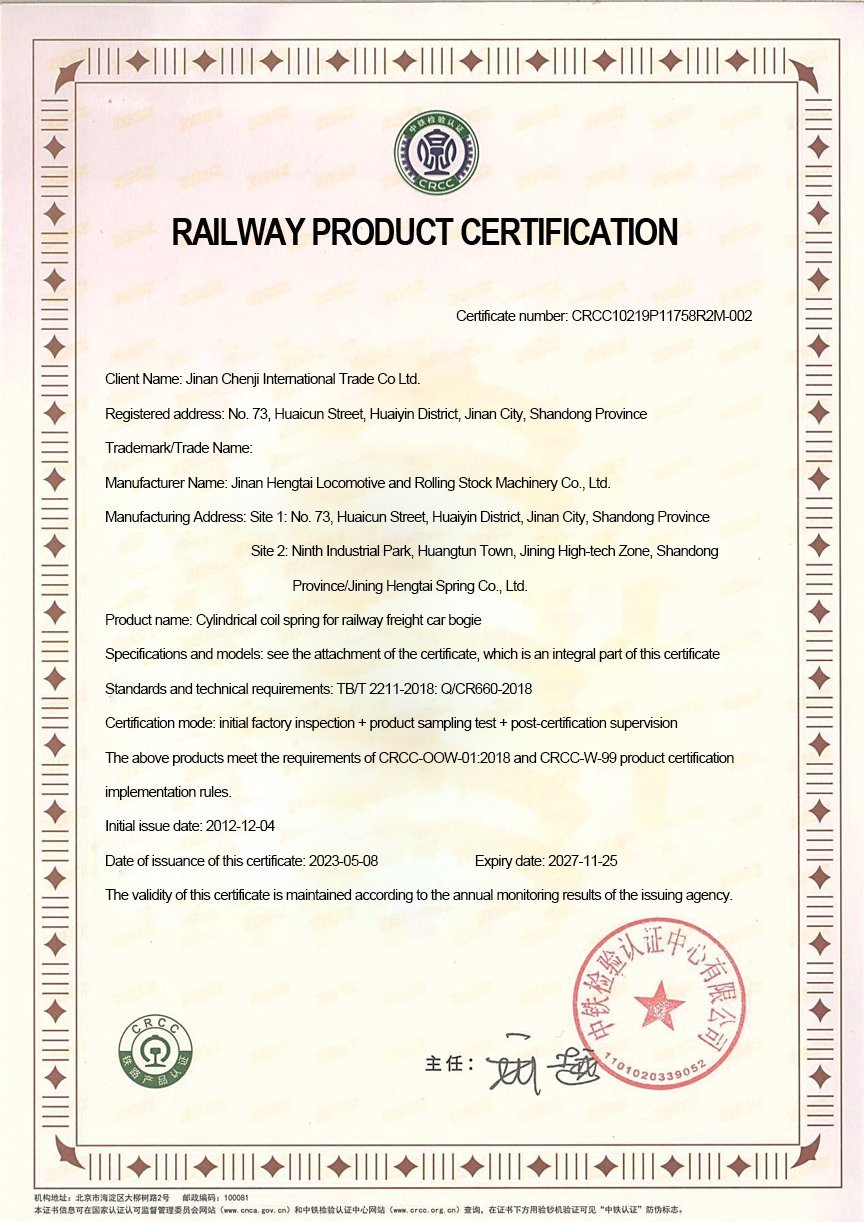
These springs are covered by the CRCC railway product certification held by CHENJI, confirming compliance with Chinese railway product certification rules.
- Certificate No.: CRCC10219P11758R2M
- Manufacturing standard: TB/T 2211-2016, Q/CR660-2018
- Valid until: 25 November 2027