Spring Engineering Notes and Tolerances
The key design parameters – free length, rate, solid height, initial tension, fatigue, buckling and more – plus what tolerance really means for springs.
The Language of Spring Design
A spring specification is a list of numbers: wire diameter, outer or inner diameter, free length, number of coils, spring rate, load at working height, end type, direction of wind and material. Get these right and the spring behaves exactly as your mechanism needs; get them wrong and the spring is scrap.
This page explains the design parameters engineers ask about most, and the tolerances that realistically apply to them.
Design Parameters
Free Length
The length of the spring with no load applied. It is the reference dimension for all load measurements.
Spring Rate
The force needed to compress or extend the spring by one unit of length (N/mm or lbf/in). It depends on wire diameter, coil diameter, active coils and material modulus.
Solid Height
The length when all coils touch. Working travel must stay below solid height or the spring will coil-bind and overload.
Deflection
The change in length under load. For a linear spring, load equals rate multiplied by deflection.
Initial Tension
The built-in force in an unloaded extension spring that must be overcome before it extends. It must be specified or the free length and rate will not match the drawing.
Set and Preset
Set is the permanent loss of length after first loading. Presetting - compressing to solid height before delivery - stabilises dimensions and can increase load capacity.
Buckling
Slender compression springs bow sideways under load. It depends on the free-length to mean-diameter ratio and on end conditions; guide rods or sockets prevent it.
Fatigue Life
Dynamic springs are rated in cycles to failure. Stress range, mean stress, shot peening and surface defects dominate fatigue life.
More Design Points
Stress: the highest stress is on the inside of the coils. The Wahl factor corrects the basic formula for curvature and direct shear; keep the corrected stress below the material endurance limit for long life.
Ends: compression springs can have closed, closed-and-ground or open ends; grinding gives a square bearing surface. Extension springs have hooks or loops; torsion springs have legs. The end style changes the active coils and the solid height.
Direction of wind: right-hand or left-hand. Always specify it for torsion springs and for springs that must nest inside one another.
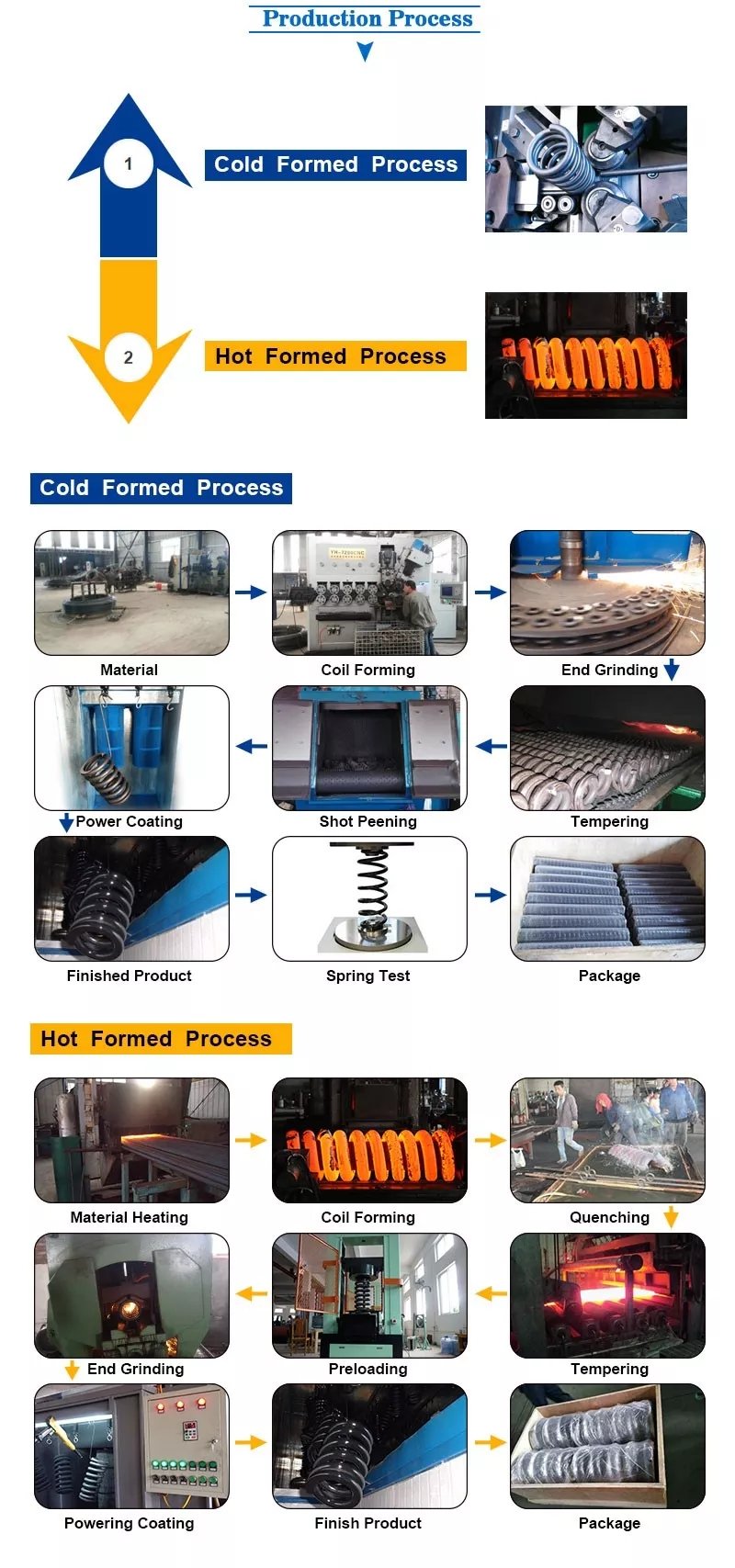
Coiling temperature: small springs are cold coiled; heavy springs from large wire or bar are hot coiled and then heat treated. The process affects material choice and tolerances.
Surging: at high operating speeds a spring can resonate. Adding damping, raising the natural frequency or using variable pitch usually solves it.
Tolerances - What Is Realistic?
Springs are made from drawn wire, formed and then often heat treated; every step adds variation. Manufacturing standards such as DIN 2095, DIN 2096, the GB/T 1239 series and the EN 13906 series define tolerance grades for free length, diameters, rate and load.
As a guide, free-length tolerances of about +/-2-5% (or a fixed millimetre value, whichever is greater) and rate tolerances of about +/-5-10% are normal production values for cold coiled springs. Tighter values are possible but cost more, because they may require 100% sorting and selection.
Tolerance only the dimensions that matter: free length and rate are usually critical, wire diameter is fixed by the material standard, and the rest can be left free. Over-tolerancing a drawing is the most common reason springs become unnecessarily expensive.
Typical Spring Tolerances (Guide Values)
Guide values for cold coiled helical springs. Hot coiled springs, very small springs and special materials can differ – always confirm with the manufacturer.
| Free length | About +/-2-5% or +/-0.5 mm, whichever is greater (grade dependent). |
| Spring rate | About +/-5-10%. |
| Outer / inner diameter | About +/-1-2% or +/-0.3 mm. |
| Load at a given height | About +/-5-10%. |
| Squareness (ground ends) | About 1-3 degrees. |
Frequently Asked Questions
Q: What information do you need to quote a spring?
Wire diameter or OD/ID, free length, number of coils or spring rate, loads at working heights, end type, material, finish and required life. A drawing is best – we can read it directly.
Q: Can you manufacture exactly to my drawing?
Yes. We manufacture to your drawing and will also propose small adjustments to tolerances, preset and end treatment that make the spring more stable and cheaper to produce.
Q: What is the difference between set and preset?
Set is the unwanted permanent deformation that occurs when a spring is first loaded. Presetting is the deliberate factory operation that loads the spring to solid height once, removing that deformation before delivery.
Designing a Spring? Talk to an Engineer
Send your sketch or drawing and get feedback on rate, tolerance and manufacturability within one working day.
Production Process