
Extension Springs: Custom Tension Spring Manufacturer
Custom extension springs (tension springs) with the hooks and loops you specify, made to your drawing, sample, free length, initial tension and load data. CHENJI is an ISO 9001 certified spring manufacturer in Jinan, China, shipping to OEM and export buyers worldwide. We wind extension springs from 0.2 mm to 90 mm wire in carbon, alloy and stainless spring steel, with machine hooks, full loops, half loops, side, long, half-round and duckbill hooks. Low, medium or high initial tension is wound in to match your preload, and every batch is checked for free length, initial tension and load tolerance before dispatch.
Overview
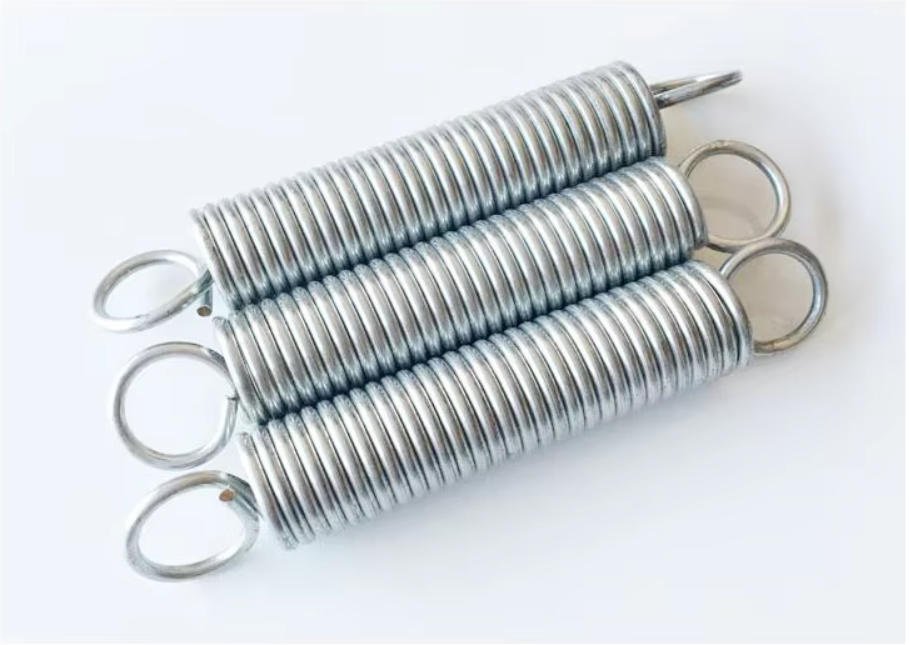
An extension spring is a close-wound helical spring that resists an axial pulling force. Unlike a compression spring, its coils are wound touching each other, and when you pull it the coils separate and resist. The force needed just to start separating the coils is called the initial tension, which acts as a built-in preload so the spring engages immediately.
Extension springs actually work in torsion like all helical springs: each coil twists slightly as the spring stretches, and that elastic energy is released when the load is removed. The relationship between load and deflection is the spring rate (N/mm), which our engineers calculate from wire diameter, mean coil diameter, number of active coils and material modulus before a single metre of wire is wound.
CHENJI manufactures extension springs from 0.2 mm to 90 mm wire (typical range, confirmed per drawing) in carbon, alloy and stainless spring steel. The end configuration – machine hook, full loop, half loop, side hook, long, half-round or duckbill hook – is chosen with your attachment point in mind, because hook failures are the most common reason extension springs fail.
Hooks, Loops & Construction
The end configuration determines how the spring attaches to your assembly – and hook failures are the most common reason extension springs fail, so the right hook design matters.
English loop
The most common end – a full closed loop in line with the spring body. Suitable for most industrial and automotive applications.
German loop
A full loop bent out of plane, giving a wider attachment point that reduces stress where the hook meets the body.
Side hook
The hook is bent to the side of the spring, used where the attachment point must sit beside the spring axis.
Long hook
An extended hook for applications where the spring must reach a distant anchor point.
Half-round hook
A simple half loop used for light loads and toys.
Duckbill (coned) hook
A flattened, tapered hook that reduces stress concentration for heavier loads.
Double hooks
Hooks at both ends as standard – including double-loop and double-side-hook configurations.
Initial tension control
Springs can be wound with low, medium or high initial tension to match the preload your mechanism needs before deflection starts.
Applications
- Garage doors and roller shutters: counterbalancing tension springs
- Automotive: return, clutch and counterbalance springs
- Agricultural machinery and implements
- Trampolines, fitness and recreation equipment
- Vending machines, automation and industrial equipment
- Appliance and furniture mechanisms
- Electronics and toys (light-load springs)
Technical Parameters Explained
Initial tension: The force required to start separating the coils. It is built in during winding and acts as a preload, so the spring engages immediately. We set it low, medium or high to match your mechanism.
Spring rate (N/mm): Load required per millimetre of deflection, calculated from wire diameter, mean coil diameter and number of active coils.
Free length: Overall length including the end hooks or loops, measured with no load applied.
Tell us the free length, hook or loop type, outside or inside diameter, initial tension and working load, and we confirm the design with a calculation sheet before production.
Specifications & Range
| Wire diameter range | 0.2 – 90 mm (typical range; confirmed per drawing). Garage/shutter tension springs commonly 0.207″ – 0.437″ (5.26 – 10.3 mm) |
| Materials | Carbon spring steel (65Mn, 77B, 82B / ASTM A229), music wire; alloy steel (60Si2MnA, 50CrVA, 55CrSi); stainless steel (SUS304, SUS316) |
| Hook / loop types | Machine hook, full loop, half loop, side hook, long hook, half-round hook, duckbill (coned) hook, double hooks |
| Initial tension | Low, medium or high – wound in to match your preload; confirmed per drawing |
| Outer / inner diameter | Per drawing (shutter tension springs typically 1 3/4″ – 6″ inner dia, 44 – 152 mm) |
| Winding | Close-wound with initial tension; direction per drawing |
| Surface options | Oiled, black oxide, galvanised / zinc plated, nickel plated, chrome plated, powder coating |
| Standards | ASTM A229, GB/T 1239.2, or custom per drawing |
| MOQ | From 10 pcs for standard sizes (typical; confirmed per drawing) |
| Sample lead time | Around 5 days after drawing approval |
| Production lead time | Within 7 – 15 working days; shipped by sea or air |
Materials & Surface Treatment
Common materials:
- Carbon spring steel: 65Mn, 77B, 82B (ASTM A229) – economical, general purpose
- Music wire – fine wire, precision instruments and electronics
- Alloy steel: 60Si2MnA, 50CrVA, 55CrSi – higher strength and fatigue life
- Stainless steel: SUS304, SUS316 – corrosion resistance, food and marine use
Surface treatments:
- Oiled – light protection for internal springs
- Black oxide – economical dark finish
- Zinc / galvanised plating – standard corrosion protection
- Nickel and chrome plating – wear-resistant, decorative finish
- Powder coating – thick, durable finish for outdoor parts
Material and finish are selected with your working environment: temperature, humidity, chemicals and required fatigue life. Tell us the conditions and we will recommend the combination.
OEM Customization
Send us your drawing, a sample or your space and load requirements – we design the hook geometry and winding parameters for you.
Send Your Drawing
Share the drawing or sample with free length, load and hook style. We confirm initial tension and rate.
Sample Approval
Prototypes are made, stretched and load-tested to your specification.
Batch Production
Production with 100% inspection of free length, hook position and load characteristics.
Frequently Asked Questions
Q: What is the difference between an extension spring and a tension spring?
A: They are the same component. “Extension spring” and “tension spring” are two common names for a close-wound helical spring that resists an axial pulling force. Some industries and regions use one term or the other – we quote to the same product either way.
Q: How do I choose the right hook or loop type?
A: Machine hooks (cross centred) and full loops suit most general uses; half loops are for light loads; side hooks suit an attachment offset from the spring axis; long hooks reach a distant anchor; half-round hooks suit light loads and toys; duckbill (coned) hooks reduce stress concentration for heavier loads. Choose the style that matches your attachment point and load – we can confirm it with your drawing.
Q: How is initial tension set?
A: Initial tension is the force needed to just start separating the close-wound coils. It is built in during winding by controlling coil pitch, and can be low, medium or high to match the preload your mechanism needs before deflection starts. We measure it and confirm it against your requirement before production.
Q: How long will an extension spring last (fatigue life)?
A: Fatigue life depends on working stress, material and surface. For dynamic, high-cycle service we recommend alloy steel such as 60Si2MnA or 50CrVA, and where needed preset or shot peening to relieve stress. Give us the cycle count and stroke and we design the spring to the required life.
Q: Can you make extension springs to my drawing?
A: Yes. We are an OEM/ODM manufacturer. Send a drawing or sample plus free length, outside or inside diameter, wire size, hook type, initial tension and working load, and we confirm dimensions and load tolerance per drawing before producing.
Need Extension Springs?
Email liu@chenjisprings.com | WhatsApp +86 158 5311 1612 | We reply within one working day.
Related Technical Resources
Deepen your spring knowledge with our free engineering guides:
Product Gallery
Related Spring Types & Tools
Design Information & Applications
Key Design Parameters
Extension springs (also called tension springs) are designed to absorb and store energy while resisting axial pulling forces, with hooks or loops at each end for attachment. Every unit is manufactured to DIN / EN / GB / ASTM as required, with materials fully traceable to the raw heat-treatment number.
| Parameter | Description |
|---|---|
| Material | Carbon steel (77B, 82B), alloy spring steel or stainless steel selected for the load and service environment |
| Wire Diameter | 10-80 mm as required, custom to your drawings and samples |
| End Type | Machine hooks, crossover hooks, extended hooks or threaded ends available |
| Surface Treatment | Oil finish, galvanized, powder coating, black oxide or customized per requirement |
Typical Applications
Extension springs are widely used wherever a pulling or retracting force is needed — from counterbalance systems to vehicle and machine assemblies.
- Garage door springs — counterbalance for sectional doors
- Automotive suspension springs — vehicle tension and damping duties
- Compression springs — complementary load-direction products
- Torsion springs — rotational counterbalance systems
- Disc springs — compact high-load stacks
Request a Quote
Send your wire diameter, free length, end style or a sample/drawing and we will confirm a competitive quotation within one working day. Contact us at liu@chenjisprings.com or WhatsApp +86 158 5311 1612.