
Torsion Springs
Custom helical torsion springs that store rotational energy and apply torque – from fine instrument springs to garage door counterbalance springs.
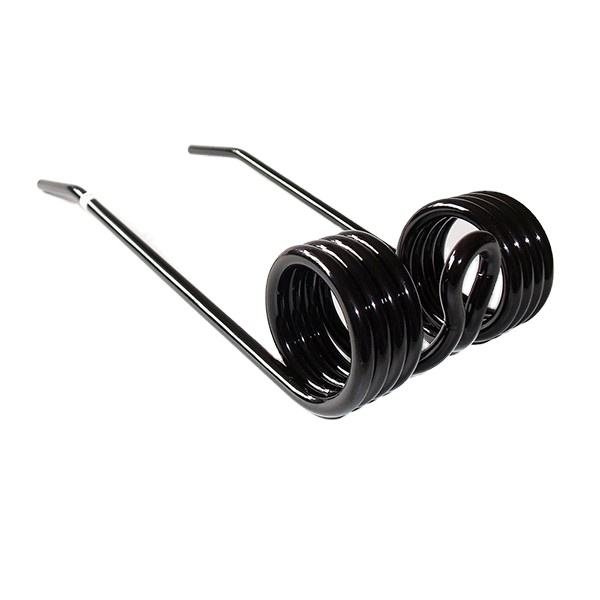
Overview
A torsion spring is a helical spring that exerts torque when twisted about its axis. Instead of being pushed or pulled, it is rotated – the legs at each end transmit the force, and the spring body stores rotational energy. Torsion springs are everywhere: garage doors, hinges, clothespins, switches and door closers all rely on them.
Torsion springs can be wound right-hand or left-hand, close-wound or open-wound, with legs bent to almost any angle and position. The torque the spring produces is proportional to the angle of deflection, and the design variables – wire diameter, coil diameter, number of coils and leg position – are calculated precisely for your mechanism.
Together with our partner factory we produce torsion springs from 2 mm to 40 mm wire, including double torsion springs and springs with complex leg forms, in carbon steel, alloy steel and stainless steel.
Winding Direction, Legs & Body Styles
Torsion spring performance depends on three things: which way it is wound, how the legs are formed, and whether the body is open or close wound.
Right-hand / left-hand winding
Winding direction determines which way the spring applies torque. Right-hand springs are standard; left-hand springs are used where space or rotation direction demands it. Garage door springs are supplied as matched left/right pairs.
Straight legs
The simplest leg form – straight extensions from the end coils, cut to the required length and angle.
Straight offset legs
Legs bent at an angle out of the body axis, used where the spring must hook onto a pin or bracket beside the body.
Hinged legs
Legs with a loop or hook at the end so the spring can be attached without separate fasteners.
Double torsion springs
Two torsion springs wound in opposite directions and joined by a common centre coil. They apply balanced, opposing torque and are used in garage doors, counterbalances and self-closing mechanisms.
Close-wound vs open-wound bodies
Close-wound bodies have coils touching (with or without initial tension); open-wound bodies have a pitch between coils. The choice affects torque, deflection range and how the spring behaves when unloaded.
Applications
- Garage door and overhead door counterbalance systems
- Roller shutter and rolling door springs
- Hinges, lids and self-closing mechanisms
- Electrical switches, relays and spring-loaded contacts
- Door closers and window hardware
- Automotive: seat recliners, pedals, throttle return springs
- Agricultural and construction machinery
- Toys, appliances and consumer products
Technical Parameters Explained
Torque: The turning force the spring produces, usually expressed in N-mm at a specified deflection angle. Torque is proportional to the angle of twist.
Deflection angle: The angle through which the spring is rotated from its free position. Maximum deflection is limited by the stress in the wire at full twist.
Winding direction: Right-hand or left-hand, chosen to match the direction of applied rotation. The spring must be wound so it tightens in use, not unwinds.
Leg position and angle: Legs can be formed at any required angle and radial position relative to the body, and at any point along the length.
Body length and diameter: The envelope the spring fits into. Body OD grows as a torsion spring is deflected, so clearance must allow for this.
Active coils: The coils between the legs that actually twist. Fewer coils mean higher torque for the same deflection.
Initial tension: For close-wound torsion springs, the torque required to start separating the coils – useful where the spring must hold a preload.
Specifications & Range
| Wire diameter range | 2 – 40 mm (partner factory capacity) |
| Materials | Carbon spring steel, alloy steel (60Si2MnA, 55CrSi), stainless steel (301, 304, 316), music wire |
| Winding | Right-hand, left-hand, close-wound, open-wound, double torsion |
| Leg forms | Straight, offset, hinged, hooked – formed to your angle and position |
| Surface options | Zinc plating, Dacromet, powder coating, phosphating, oiled |
| Standards | DIN 2088, JIS B2708, GB/T 1239.3 or custom per drawing |
Materials & Surface Treatment
Common materials:
- Carbon spring steel (SWC) – economical, general purpose torsion springs
- Alloy steel 60Si2MnA / 55CrSi – high torque and fatigue applications
- Chromium-vanadium 50CrVA – dynamic service and elevated temperature
- Stainless steel 301 / 304 / 316 – corrosion resistance, outdoor and food contact
- Music wire – fine springs for instruments and precision mechanisms
Surface treatments:
- Zinc plating – standard corrosion protection
- Dacromet – salt-spray resistance without hydrogen embrittlement
- Powder coating – durable outdoor finish
- Phosphating – oil-holding base coat
- Oiled – light protection for internal springs
Because torsion springs see bending stress at the legs and torsional stress in the body, material strength and surface quality matter. We select the grade and finish around your load, cycle and environment.
OEM Customization
Tell us the torque, the deflection angle and the space you have – we design the winding and leg geometry around your mechanism.
Send Your Drawing
Drawing or sample with torque, angle and leg position. We calculate wire and coil design.
Sample Approval
Prototype springs are wound, heat-treated and torque-tested against your specification.
Batch Production
Series production with leg-angle and torque inspection on every batch.
Frequently Asked Questions
Q: What is the MOQ for torsion springs?
No fixed MOQ for prototypes and small batches. Production MOQ depends on wire size and leg forming – confirmed with your inquiry.
Q: How long does sampling take?
Samples are normally produced within days of drawing approval. We confirm the schedule for your specification.
Q: How do I know if I need right-hand or left-hand winding?
The spring must wind tighter in the direction of rotation. If you send us the mechanism or a drawing, we confirm the correct winding and leg position.
Q: Can you make double torsion springs?
Yes. Double torsion springs with a common centre coil are standard for counterbalance and self-closing applications.
Q: What is the maximum deflection angle?
It depends on wire diameter, coil count and material stress. We calculate the safe deflection for your design and can recommend a larger coil count if you need more travel.
Need Torsion Springs?
Email liu@chenjisprings.com | WhatsApp +86 158 5311 1612 | We reply within one working day.
Related Technical Resources
Deepen your spring knowledge with our free engineering guides:
Related Spring Types & Tools
Design Information & Applications
Key Design Parameters
Torsion springs exert rotational (torque) force when twisted, with legs or hooks anchoring them at each end. They are built to close coiled tolerances and manufactured to DIN / EN / GB / ASTM as required, in single or double torsion form.
| Parameter | Description |
|---|---|
| Material | Spring steel music wire, flat wire, 60Si2Mn, 50CrVA, carbon steel (77B, 82B) or stainless steel |
| Wire Diameter | 0.4-45 mm standard; custom per drawing or sample |
| Form | Single torsion or double torsion, with straight, offset or hooked ends |
| Surface Treatment | Nickel, zinc, oil-tempered, powder coating, galvanized or customized finish |
Typical Applications
Torsion springs deliver precise rotational control and counterbalance in doors, vehicles and industrial equipment.
- Garage door springs — torsion counterbalance for sectional and roller doors
- Automotive suspension springs — vehicle and seat mechanisms
- Compression springs — linear-load applications
- Extension springs — tension counterbalance systems
- Disc springs — compact high-load stacks
Request a Quote
Send your wire diameter, number of coils, leg angle or detail drawing and we will confirm a competitive quotation within one working day. Contact us at liu@chenjisprings.com or WhatsApp +86 158 5311 1612.