
Compression Springs: Custom Coil Spring Manufacturer
Custom helical compression springs made to your drawing, sample or load data – produced in China and shipped to OEM and export buyers worldwide. CHENJI is an ISO 9001 certified manufacturer holding CRCC railway product certification. We wind compression springs from 0.2 mm to 90 mm wire in carbon, alloy and stainless spring steel, in cylindrical, conical, barrel and hourglass bodies, with closed and ground, closed, plain or plain-ground ends. Preset, shot peening, heat treatment, galvanising and powder coating are available. Tell us your load, deflection and envelope, and our engineers confirm the design.
Overview
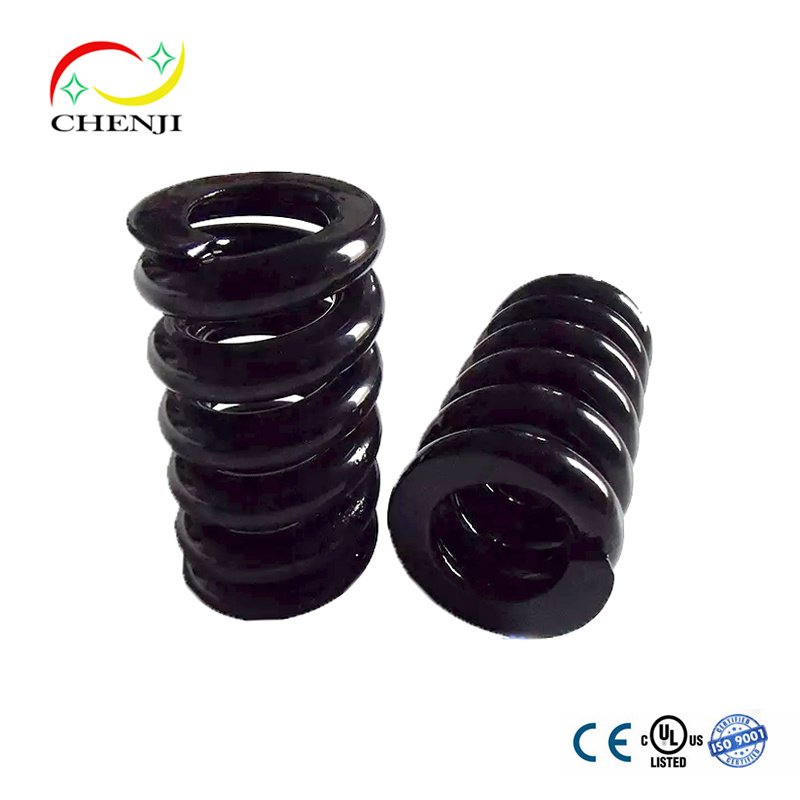
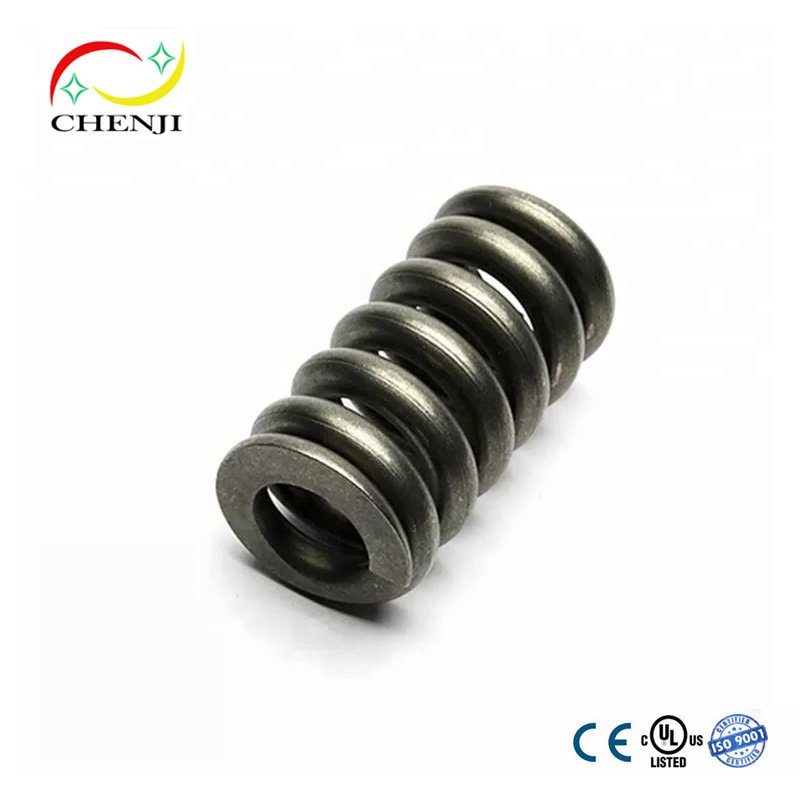
A compression spring is an open-coil helical spring that resists axial compressive force. When the spring is pushed together it stores mechanical energy, and when the load is removed it returns to its original free length. Because the design is simple, predictable and highly reliable, compression springs are the most widely used spring type in mechanical engineering.
Compression springs actually work in torsion: every coil twists slightly as the spring compresses, and that elastic energy is released as the spring rebounds. The relationship between load and deflection is the spring rate (N/mm), which our engineers calculate from wire diameter, mean coil diameter, number of active coils and material modulus – before a single metre of wire is cut.
CHENJI manufactures compression springs from 0.2 mm to 90 mm wire (typical range, confirmed per drawing) in carbon, alloy and stainless spring steel, with closed and ground ends as standard. We offer preset, shot-peened and stress-relieved springs for high-cycle applications, and every batch is checked for free length, rate and load tolerance before dispatch.
Types & Construction
The right end configuration and body shape depend on how the spring seats and where it works. We produce all common variants.
Closed and ground ends
The standard choice for precision springs. End coils are closed (pressed flat) and ground square so the spring seats evenly, resists buckling and distributes load uniformly across the mating surface.
Closed ends, not ground
End coils are closed but not ground. Cheaper than ground ends and adequate when seating flatness is less critical – typical for general industrial springs.
Plain ends (open)
The spring is cut with open, unclosed ends. The lowest-cost option, used where the spring sits in a pocket or on a rod and end flatness is not required.
Plain ends, ground
Open ends ground flat. A compromise used when the spring must stand square without closed end coils.
Conical (tapered) springs
Coil diameter reduces toward one end. Conical springs offer a low solid height, a stable seating base and can be nested inside one another to save axial space.
Barrel and hourglass springs
Barrel springs are wider in the middle, hourglass springs are narrower in the middle. Both control lateral stability and reduce buckling on long, slender springs.
Applications
- Railway: train bogie and suspension springs
- Automotive: suspension, engine valve and clutch springs
- Mining and quarrying: vibrating screen, crusher and excavator recoil springs
- Elevators and lifting: elevator buffer springs
- Agricultural machinery and implements
- Industrial equipment, automation and vending machines
- Furniture and seating: office and barber chair springs
- Gym and sports equipment: spring-loaded floors
Technical Parameters Explained
Spring rate (stiffness): The force needed to compress the spring by one millimetre (N/mm). Rate depends on wire diameter, mean coil diameter, active coils and material modulus – change any one and the rate changes.
Shear stress: The maximum stress in the wire under load. It must stay below the material’s allowable limit or the spring will take a permanent set or fail in fatigue.
Free length: The overall length of the spring with no load applied. This is the length you specify on the drawing.
Solid height: The length of the spring when every coil is touching – the physical limit of compression. A spring must never be designed to reach solid height in service.
Active coils: The coils that actually flex under load. End coils are closed and inactive; the number of active coils drives the rate calculation.
Total coils: Active coils plus end coils. Total coils determine the free length for a given pitch.
Wire diameter: The diameter of the wire the spring is wound from. It is the single most influential factor on both rate and stress.
Outer / inner diameter: The envelope the spring must fit. Outside diameter must clear the bore, inside diameter must clear the rod, and both grow slightly under compression unless guided.
Pitch: The distance between adjacent coil centres. Pitch sets the free length and the maximum deflection before coils touch.
End grinding: Ground ends give a flat, square seating surface – essential for tall springs and precise load applications.
Specifications & Range
| Wire diameter range | 0.2 – 90 mm (typical range; confirmed per drawing) |
| Materials | Carbon spring steel (65Mn, 82B / ASTM A229, SWC); alloy steel (60Si2Mn, 60Si2MnA, 55CrSi, 50CrVA); stainless steel (301, 302, 304, 316, 321); music wire (ASTM A228) |
| End types | Closed & ground, closed, plain, plain & ground |
| Body shapes | Cylindrical, conical, barrel, hourglass |
| Hardness | Typically HRC 45 – 50 |
| Winding direction | Right-hand or left-hand |
| Surface options | Galvanised / zinc plated, chrome plated, nickel plated, electrophoretic (e-coating), powder coating, black oxide, oil tempered |
| Standards | ASTM A228 / A229, GB/T 1239.2, DIN 2093 (disc springs), or custom per drawing |
| MOQ | From 10 pcs for standard sizes (typical; confirmed per drawing) |
| Sample lead time | Around 5 days after drawing approval |
| Production lead time | Within 7 – 15 working days; shipped by sea or air |
Materials & Surface Treatment
Common materials:
- Carbon spring steel: 65Mn, 82B (ASTM A229), SWC – economical, general purpose
- Alloy steel: 60Si2Mn, 60Si2MnA, 55CrSi – higher strength and fatigue life
- Chromium-vanadium 50CrVA – dynamic and high-temperature service
- Stainless steel: 301 / 302 / 304 / 316 / 321 – corrosion resistance, food and marine use
- Music wire (ASTM A228) – fine wire, precision instruments
Surface treatments:
- Zinc / galvanised plating – standard corrosion protection
- Chrome plating and nickel plating – wear-resistant, decorative finish
- Electrophoretic (e-coating) – even coverage across complex coils
- Powder coating – thick, durable finish for outdoor parts
- Black oxide and oil tempered – light protection for internal springs
Material and finish are selected together with your application environment: temperature, humidity, chemicals and required fatigue life. Tell us the working conditions and we will recommend the combination.
OEM Customization
From a drawing, a sample or even a sketch – we take your compression spring from concept to production.
Send Your Drawing
2D or 3D drawing, or just load, deflection and space data. Our engineers confirm the design and rate calculation.
Sample Approval
Prototype samples are produced and tested against your specification for load, length and finish.
Batch Production
Mass production with 100% key-dimension inspection, heat treatment records and on-time delivery.
Frequently Asked Questions
Q: What is the MOQ for compression springs?
A: Standard sizes start from 10 pcs; prototype and small-batch orders are welcome. For custom wire sizes and processes the practical MOQ depends on the specification, and we confirm it with your inquiry.
Q: Which material should I choose – carbon, alloy or stainless steel?
A: Choose carbon spring steel (65Mn, 82B) for general-purpose economy, alloy steel (60Si2Mn, 60Si2MnA, 55CrSi, 50CrVA) where higher strength and fatigue life are needed, and stainless (301/302/304/316/321) for corrosion, food or marine environments. Send us the working conditions and we will recommend the grade.
Q: What hardness and tolerances can you hold?
A: Compression springs are typically heat treated to HRC 45-50. We wind to your drawing or to ASTM A228/A229, GB/T 1239.2 and DIN 2093 tolerance classes, with load tolerances typically around +/-10% or tighter if required.
Q: What certifications and quality checks do you provide?
A: Our factory is ISO 9001 certified (certificate 626024QH073R1) and holds CRCC railway product certification (CRCC10219P11758R2M), with a Bureau Veritas factory audit (MIC-ASR2451820). Every batch is inspected for free length, rate and load tolerance, with heat-treatment records on request.
Q: How fast are samples and production, and what do you need to quote?
A: Samples take around 5 days after drawing approval; production is normally within 7-15 working days, shipped by sea or air. To quote, send wire diameter, inner or outer diameter, free length, total and active coils, end type, winding direction, material and finish – or simply send a drawing or sample.
Need Compression Springs?
Email liu@chenjisprings.com | WhatsApp +86 158 5311 1612 | We reply within one working day.
Related Technical Resources
Deepen your spring knowledge with our free engineering guides:
Product Gallery
Related Spring Types & Tools
Design Information & Applications
Key Design Parameters
Compression springs are the most widely used spring form, engineered to absorb and store energy while resisting axial compressive loads. Every unit is manufactured to DIN / EN / GB / ASTM as required, with full traceability of the raw coil to its heat-treatment number.
| Parameter | Description |
|---|---|
| Material | Alloy steel (60Si2Mn, 60CrMnA, 50CrVA, 60Si2CrA), carbon steel (SWC, 65Mn, 65#, 70#), music wire (SWP) or stainless steel (SUS304, SUS302, SUS316L) |
| Wire Diameter | 0.8-40 mm standard; custom up to 80 mm per your drawings |
| End Type | Plain end, closed end or closed & ground to suit load and seating requirements |
| Surface Treatment | Black oxide, powder coating, zinc plating or nickel plating as required |
Typical Applications
Compression springs deliver reliable, long-life performance across demanding industrial and mechanical duties. Common uses include valve assemblies, automotive suspension, agricultural equipment and general machinery.
- Extension springs — complementary tension-load products
- Torsion springs — rotational force applications
- Disc springs — high-load, limited-space stacks
- Automotive suspension springs — vehicle ride and handling
- Railway suspension springs — heavy transport shock absorption
Request a Quote
Send your wire diameter, free length, coil count or detail drawings and we will confirm a competitive quotation within one working day. Contact us at liu@chenjisprings.com or WhatsApp +86 158 5311 1612.